
We Can Still Have Nice Things
Or: a future somebody can actually see

The last few months of being an American have been depressing. I am an optimist by temperament and by practice, and lately a thought has been creeping in at the edges. The thought that maybe things just won’t get better. Maybe this is a slope that points only down.
I am not sure I believe it. But I have felt it, and I think a lot of you have, too, and pretending otherwise is how this whole problem started. I’ve have hatched a budding nihilism that is out of character and that I don’t like and that is in direct conflict with my usual nature. It has caused deep self-reflection, and after much work I believe I understand it, or at least know what to do with it.
Before I share what I really believe, I want to acknowledge that feeling. Because I think the feeling is the point. Not as wallowing. As data. We don’t feel the slope unless the ground is actually moving, and the ground has been moving for a long time, and a lot of us have been told that the movement is in our heads.
It isn’t.
Let’s talk about what I actually believe, and then let me tell you why I’m going to spend the next stretch of writing proving it.
I believe we can still have nice things.
Not someday. Not if we’re good. Not if the right person finally arrives to save us. Now, with what we already have, but only if we decide it’s not optional anymore.
We cannot build a thing we cannot picture. If I can’t see a better world, I can’t believe in it. If we can’t believe in it, we won’t act for it. And nothing gets built without me first believing the building is worth starting.
Call it faith if you want. I’ll use the word, carefully. Faith precedes action. You do not pick up the tool unless you believe it has the potential to do something. That’s not a religious claim. It’s a description of how anyone has ever built anything.
Which means the most important work right now, more important than another study, another white paper, another well-sourced explanation of how bad it is, is showing people what the other way actually looks like. Concretely, so they can see it. Then they can want it.
That’s the project. Someone needs to stand up and point at the mountaintop and say that’s where we’re going, and we’re going together, and we’ll argue plenty on the way, but that is the direction.
Belief is hard right now because the obstacle is the point.
Rising authoritarianism runs on a single trick. It tells you there was a magical past, that the past was stolen from you, and that only one person can give it back. Every word of that is a lie, but it’s a lie that fills a hole, and the hole is real. The hole is the absence of any picture of the future.
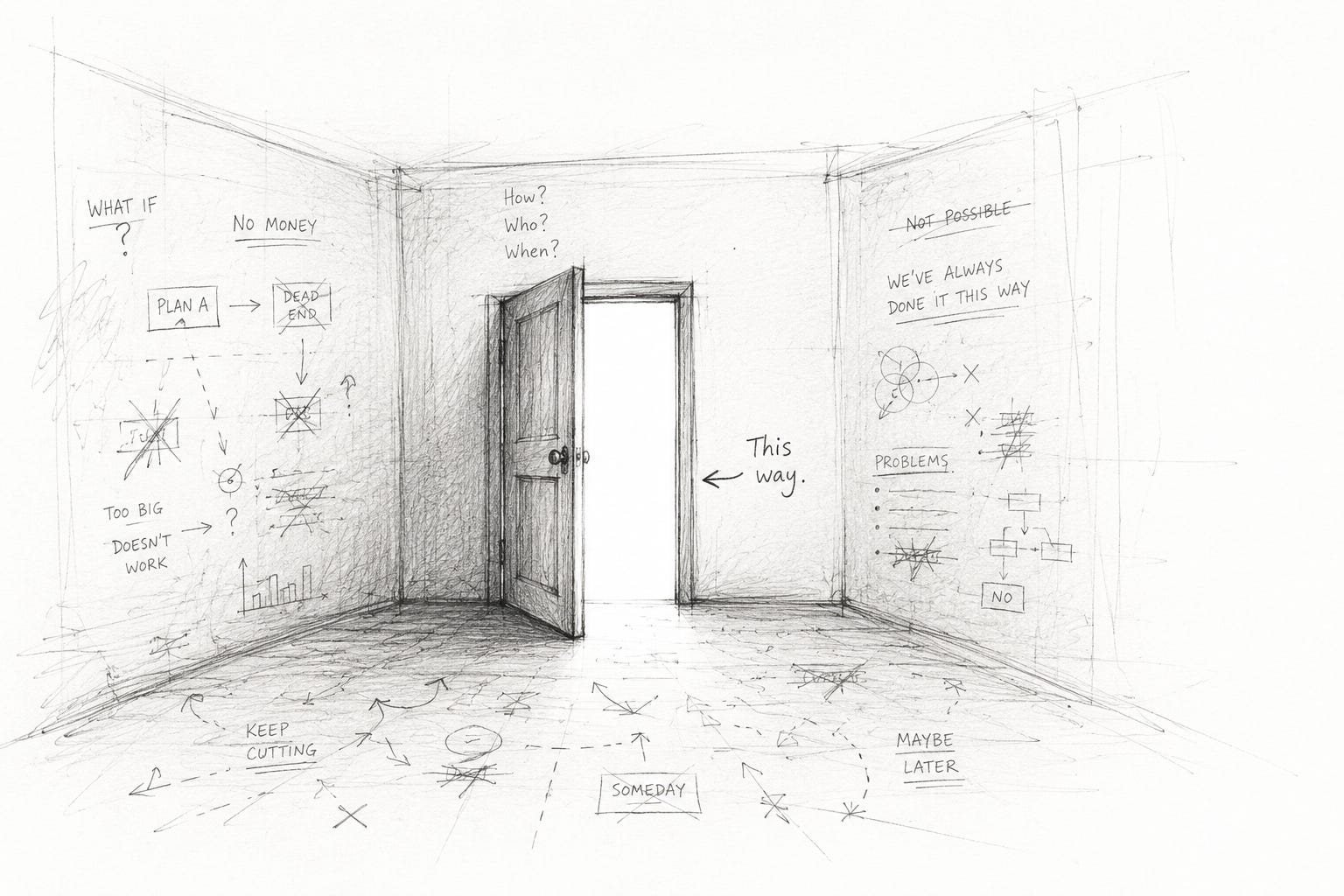
If we want to understand why the lie works, think back to the lockdown. Not the fear. The other thing. The loss of tomorrow. We stopped being able to see past the next day, let alone the next month. I remember standing in my kitchen, the kitchen that had been the most purposeful room in my life for twenty-five years, and feeling it turn into just a room. The stove was the same stove. The pots were the same pots. But something had gone out of the work, because work without a future is just repetition. I couldn’t stand up straight, and I couldn’t see out.
That feeling didn’t end when the lockdown did. A lot of us still live in that room. And a movement that promises to restore the past is just selling a different low ceiling, painted to look like the sky.
The answer to a stolen past is not a better past. It’s a future somebody can actually see.
Much stands between our world now and the better one ahead.
We have been told, over and over, that there is no money. No money for the things we want. No money for the things other countries already do. And when that doesn’t work, we’re told our country is simply too big to do what works somewhere else.
These are not honest arguments; they are misdirection, and some of them are just lies. They all do the same job. They keep us from believing good things are possible, because a people who believe they are possible start asking why we don’t have them.
The Classic Arguments Against Doing Something Good
“We can’t afford it right now.” The permanent state of “right now.” The cost of inaction compounds every year, but the conversation resets to zero every budget cycle as if the problem just arrived.
“It sounds good in theory, but it won’t work in practice.” The demand that a proposed solution be flawless before it replaces a status quo that is already failing. The current system is not working in practice either. Nobody is asked to defend that.
“That’s a slippery slope.” If we do this one thing, we’ll have to do everything. The argument that because a problem has adjacent problems, we should solve none of them.
“People need to take personal responsibility.” The assertion that structural failure is actually millions of simultaneous individual moral failures, all happening to the same demographic, in the same zip codes, at the same income levels, by coincidence.
“The government can’t run anything efficiently.” Said while driving on public roads to a publicly funded airport, checking a publicly regulated weather forecast, and depositing a paycheck into a federally insured bank account.
“It will raise taxes.” The math that counts the tax increase but never counts the cost already being paid through emergency rooms, insurance premiums, lost wages, and reduced property values. The tax is visible. The existing cost is distributed across twelve line items nobody reads.
“The market will sort it out.” The market sorted it out. This is what it sorted into. The current outcome is the market’s answer. The question is whether we like the answer.
“There’s no proof it works.” Said about programs with decades of data from multiple countries while defending a status quo that has never once been asked to prove it works.
“That’s socialism.” The word that replaces the need for a counterargument. It does not describe a policy. It describes a feeling about a policy. The fire department is socialism by this definition. Nobody is proposing we defund the fire department.
“Why should I pay for someone else’s problem?” You already are. You are paying for it in higher insurance premiums, higher property taxes to fund emergency services, higher prices to cover retail theft driven by desperation, and lower economic growth in your own community. The only question is whether you’d prefer to pay less and get a better outcome.
“Where does it end?” It ends where the math stops working. Every proposal on the list has a cost-benefit analysis. The question has a quantifiable answer. The people asking it rarely want the answer.
“It creates dependency.” The argument that helping people makes them helpless, applied exclusively to individuals and never to corporations receiving subsidies, tax abatements, or regulatory protection. Dependency is only a concern when the recipient is poor.
“We should focus on what we can control.” Meaning: someone else’s problem. The boundary of “what we can control” contracts exactly to the edge of what requires no action or expenditure from the person drawing the boundary.
“It’s too complicated.” The complexity is the point. Incumbent interests use complexity as a moat. If the solution were simple, it would threaten someone’s revenue stream. The complication is not an accident. It is a feature of the system being protected.
“Now’s not the right time.” It was not the right time last year either. Or the year before. The right time is a date that never arrives because arrival would require spending money, and the whole point of the argument is to avoid spending money while appearing to care about the problem.
Then you look up. And you see the rules bent for some and enforced for others. You see policy after policy that favors the people who already have everything, and something shifts. People are finally starting to see the rich and the powerful as at least as dangerous as we’ve spent decades being told one another are.
That shift is the most hopeful thing happening in this country right now. Not because anger is good. Because the anger is finally pointed in a direction that’s actually true.
I am growing tired of saying this is not about left versus right. I worry it’s starting to sound like cheap slogan. But it’s not. The real framing is that it is about up versus down. It is about us versus them, where them is not your neighbor with the other yard sign. That is the arrangement that has both of us convinced that the other one is the problem.
I believe this project is going to live or die on specifics, and I’d rather show you now than promise you later. Here are a few examples.
A municipality can open a cooperative to make a thing the market has abandoned. We learned this the hard way in 2020, when we needed masks and gowns and discovered we’d shipped the entire capacity overseas to save a few cents a unit. A city, a county, a state can stand up a factory to build the thing missing from its own economy, owned by the workers who run it. The government takes an equity stake to get it going, and once it clears a set threshold, the public gets its investment back and walks away, and the thing belongs to the people who do the work. The goal was never ownership. The goal was ignition and the meeting of local needs.
I’ve spent twenty-five years in professional kitchens. You learn early that a kitchen only works when everyone in it understands they need each other. The line cook needs the prep cook needs the dishwasher. When management figures out how to convince those three people that they’re in competition rather than a partnership, the kitchen falls apart, and management pays less. That trick scales. We can organize labor again, and we will have to. Not as nostalgia, but as leverage.
Town after town is handing out permits for enormous data centers, signing away electricity and water, while we’re told the same machines will take our jobs and offered no plan for what comes after. It feels like watching someone walk up the driveway to take your livelihood while the people who are supposed to defend you hold the door.
There are dozens more issues. Each one gets its own piece. This piece is the table of contents, not the argument.
To be clear, I am not describing communism. I am not asking for a centrally planned economy where a bureau decides what gets made. What I’m describing is simpler and older than any ideology. A country should not lack the moral strength to house the people sleeping on its streets. It should not run on a population that lies awake, afraid of growing old, getting sick, and having nothing to retire on. It should not place the entire risk of being alive on the individual while socializing every risk for the donor class.
We have built exactly that. Rugged capitalism for you. A soft, warm, fully insured socialism for them.
The reason we can’t fix it one piece at a time is that each piece, taken alone, can be knocked down with a little rhetoric and a lot of bad faith. Universal healthcare, on its own, sounds expensive. The child benefit, on its own, sounds like a handout. Each brick is easy to kick over. The wall is harder. That’s why this has to be a picture of the whole house, not a debate about one brick.
The Democratic Party spent decades marching away from labor and toward big donors, and that march is precisely what let the other side say, with a straight face, that Democrats don’t deliver. It’s hard to argue you’re the party of working people while you’re taking the working people’s seat at the table and giving it to the people who fund the campaign.
And then there’s means-testing. One program after another, sliced and qualified and income-capped, until the help is buried under so much paperwork that half the people it’s for never see it. I remember the argument that we shouldn’t have universal programs because we wouldn’t want a rich man’s children getting the same benefit as everyone else. That argument is exactly backward. The benefit that goes to everyone is the benefit nobody can take away, because everyone is standing on it. The means test isn’t fiscal prudence. It’s a line drawn between us, and the line is the whole point. It is also significantly less expensive to manage.
Both parties, when you watch, prefer the social battlefield. There are real differences there, and they matter. But notice how rarely the fight is about the kitchen table, and ask yourself who benefits from that.
There’s a cost to all this that’s bigger than any single policy.
We are the first American generation whose lives are not materially better than our parents’. Whether anyone will admit it or not, that was a design choice. Designs can be redrawn.
I think it took a collapse this complete to drag into daylight what was running in the dark the whole time. That’s not nothing. You can’t fix what you refuse to see, and a lot of people are seeing it now for the first time.
So here’s what this is.
I’m going to take these issues one at a time. Housing. Health. Work. Retirement. Food. The court. The factory that the market abandoned. The data center draining the reservoir. I’m going to try to describe, as clearly as I can, what the better version actually looks like. Not as a wonk handing down conclusions, though I’ve done the reading. As someone who has worked fifty jobs and run kitchens for twenty-five years and watched, up close, who gets served and who gets used.
I don’t believe in hope.
At least not the way people usually mean it, where you wait, and behave, and trust that someone is coming to save you. To me, that kind of hope is a four-letter word. It’s a way of sitting still that feels like doing something.
What I believe in is harder and, ultimately, more tangible. We can show the world the place we want to live, the work it takes to get there, and then start doing the work. Not the mountaintop as a wish. The mountaintop as a destination, with a road that we design and walk together.
We can still have nice things. I steadfastly believe this. What we lack isn’t the money, or the knowledge, or the examples, because they exist all over the world and many even existed here before. What we lack is the will, the patience, and the effort. Those, unlike a stolen past, are things we can actually choose and act on.
I’m choosing to act. I hope you’ll come along with me.
Tim Brice is a chef, author, and the creator of Big Ideas With Tim, a platform that examines how closed systems protect the people at the top at the expense of everyone else. His first book, The Diamond Pyramid: Saving American Baseball by Breaking It, is available now. His second book, We Can Still Have Nice Things will be out in 2027. This isn't about left or right. It's about who's up and who's down.